
How to stop dog barking starts with one unglamorous step: figure out what your dog is “saying” and what keeps getting rewarded, even by accident. Most excessive barking isn’t “bad behavior,” it’s communication plus a habit that works.
If you’re dealing with noise complaints, disrupted sleep, or a dog who seems constantly on edge, it’s worth addressing early. Barking often escalates because the trigger repeats daily and the dog rehearses the response, doorbells, delivery trucks, squirrels, you name it.
This guide walks through the most common causes, a quick self-check to pinpoint your dog’s pattern, and practical training plans you can run at home. You’ll also see where management matters more than training, and when it’s smart to bring in a professional.
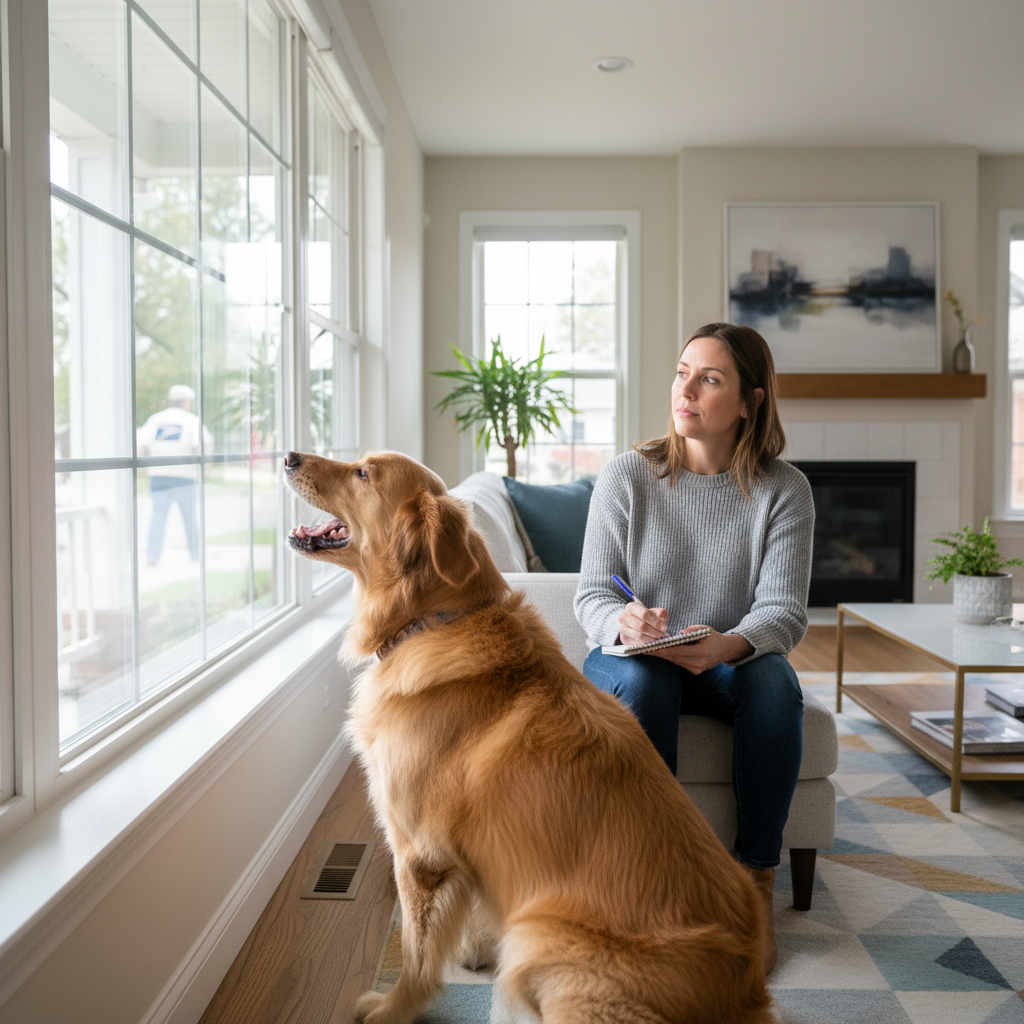
Why dogs bark excessively (the “why” matters more than the noise)
Before you try to stop barking, you need the function of the behavior, what the barking achieves for your dog. Different motivations need different fixes, and mixing them up is why many “quiet” tips fail.
- Alarm/territorial barking: doorbells, footsteps in the hallway, people passing windows, other dogs. The barking often makes the “intruder” go away, so the dog feels proven right.
- Attention-seeking: barking reliably gets eye contact, talking, petting, or even “No!” This is common with bright, social dogs.
- Boredom/under-enrichment: long stretches without mental work, especially in young dogs and working breeds.
- Fear/anxiety: noises, strangers, being left alone. You’ll often see tension, pacing, panting, or scanning.
- Frustration/excitement: leash reactivity, fence running, seeing dogs through the window, “I want to go say hi.”
- Medical or age-related factors: pain, hearing loss, canine cognitive dysfunction in seniors. If barking changes suddenly or comes with other symptoms, treat it as a health question too.
According to the American Veterinary Medical Association (AVMA), behavior concerns can have medical contributors and may benefit from a veterinary evaluation before or alongside training.
Quick self-check: what kind of barking is this?
Use this list for two days and you’ll usually spot the pattern fast. Keep it simple, you’re not building a spreadsheet for fun, you’re finding leverage.
- When does it happen? morning rush, evening, only when you’re on calls, only when alone
- Where does your dog bark? window, door, crate, yard fence, hallway
- What happens right before? doorbell, dog outside, you sit on the couch, you grab keys
- What do you do next? talk, shout, approach the dog, give a treat, let the dog outside
- How does it end? trigger leaves, you give attention, dog gets moved, dog gets a chew
- Body language? loose/wiggly vs stiff, hackles up, pinned ears, tail high and tight, trembling
If barking appears mainly when you’re gone, that leans toward separation-related distress. If it spikes at windows and doors, it’s often territorial rehearsal. If it happens the second you start a Zoom meeting, attention is usually in the mix.
Pick the right plan: a practical table by trigger
Below is a quick “match the tool to the job” table. You can combine approaches, but try one primary plan for 10–14 days so you can tell what’s working.
| Common trigger | What barking is doing | What to do first | Training focus |
|---|---|---|---|
| Doorbell/knocks | Alarm + habit | Manage: doorbell routine, block access | Place/settle, desensitization to sound |
| People/dogs outside windows | Territorial rehearsal | Reduce visual access, use frosted film | Look-at-that (LAT), reinforce calm disengage |
| Barking when you’re busy | Attention works | Stop paying for barking | Teach “quiet” + reward alternative behaviors |
| Yard/fence barking | Chasing off triggers | Supervise, shorten outdoor time | Recall away from fence, enrichment indoors |
| Alone-time barking | Distress | Vet check, safety plan | Gradual departures, independence skills |

Core skills that reduce barking in most homes
You don’t need a dozen cues. You need a few skills that change your dog’s default response. This is the part people skip, then they wonder why the dog “won’t stop.”
1) Teach a real “Quiet” (and don’t start by demanding silence)
Counterintuitive but effective: start by putting barking on cue so you can then teach the off-switch.
- Pick a low-stakes moment (not peak trigger), wait for one or two barks, then say “Speak,” mark with “Yes,” and reward.
- After a few reps, say “Quiet,” hold a treat to your dog’s nose. When barking pauses to sniff, mark and reward.
- Extend the quiet by half-seconds, then seconds. Keep sessions short, 2–3 minutes.
- Move to mild real-life triggers once the pattern is clear.
What matters: you’re not bribing mid-meltdown, you’re building a predictable skill when the dog can still think.
2) Build a “Place” or mat settle for door and window drama
If your dog has a default job, “go to mat,” you get out of the constant correction loop. It also gives guests something to expect.
- Lure your dog onto a mat, reward for standing, then sitting, then lying down.
- Add a release word (“Okay”) so your dog learns staying put earns rewards.
- Practice while you touch the doorknob, open the door a crack, then fully open.
For many households, this is the closest thing to a “volume knob.”
3) Reinforce “disengage” from triggers (Look-at-That/LAT)
When your dog spots a trigger and looks back to you for payment, barking has less room to start.
- Stand far enough away that your dog notices the trigger but stays under threshold, meaning no lunging, no rapid-fire barking.
- Mark the moment your dog sees the trigger, then reward when your dog turns back.
- Over days, reduce distance slowly, if barking starts, you got too close.
According to the American College of Veterinary Behaviorists (ACVB), behavior modification often centers on changing the emotional response, not only suppressing the behavior.
Hands-on strategies by scenario (what to do this week)
This section is where most people get unstuck. Pick the scenario that matches your home, run it for a week, and adjust from there.
Doorbell and guest barking
- Management first: put a baby gate up, use a leash indoors, or stage your dog behind a closed door for deliveries.
- Rehearse the routine: doorbell sound at very low volume, dog goes to “place,” treat scatter on the mat, repeat.
- Add a “find it” scatter: toss 5–10 small treats away from the door. Sniffing slows arousal and buys you time.
Window barking at passersby
- Change the picture: frosted window film, curtains, or move furniture so the dog can’t camp at the glass.
- Schedule watch time: short, supervised window sessions with rewards for calm looking, then end before the dog spirals.
- Teach a pattern: “Look” (at trigger) then “This way” (turn off) then reward.
Yard and fence-line barking
- Don’t leave the dog out alone if barking is the main activity. Many dogs practice for months and it becomes automatic.
- Interrupt early, call back, reward, then give another outlet such as sniff walk, food puzzle, or tug game.
- If the yard is unavoidable, consider visual barriers along the fence line in problem spots.
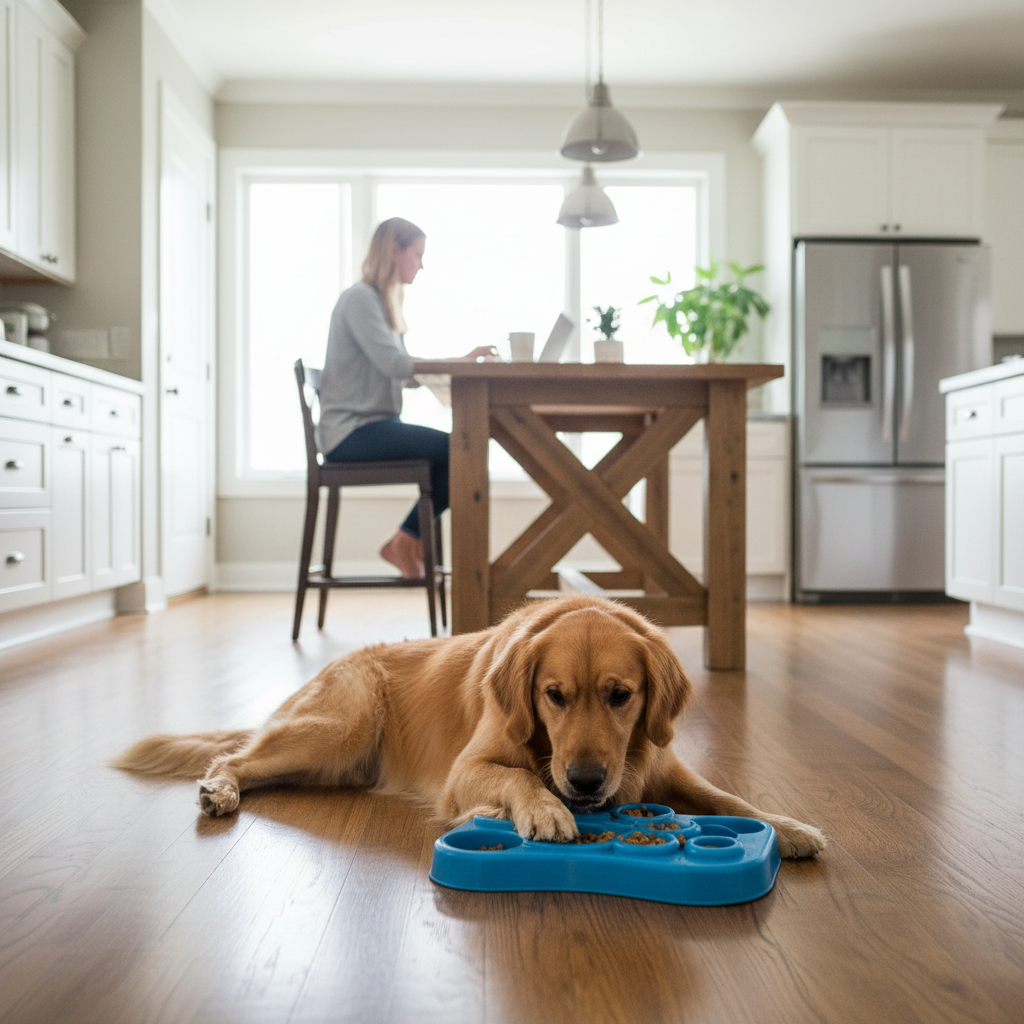
Attention barking when you’re working from home
- Pay the quiet: randomly drop treats when your dog rests, before barking starts.
- Make barking unprofitable: if barking is for attention, avoid eye contact and talking, then reward the first second of calm.
- Use “office hours” enrichment: a stuffed Kong-style toy, lick mat, or chew that lasts 15–30 minutes.
Common mistakes that keep barking going
A lot of barking persists because humans accidentally train it. Not because you’re doing something “wrong,” but because dogs learn fast and we’re busy.
- Yelling “Quiet!” can sound like you’re barking too, and it still counts as attention.
- Waiting until the dog is frantic then trying to train. Learning drops sharply when arousal is high.
- Inconsistent rules, laughing at barking sometimes, correcting other times. Intermittent rewards make habits stubborn.
- Too much freedom at windows/yard while you “work on training.” Management is not failure, it’s part of the plan.
- Underestimating sleep and exercise. Many dogs bark more when overtired, not only when under-exercised.
Also, be cautious with tools marketed as quick fixes. Aversive devices such as shock collars can carry welfare risks and may worsen fear in some dogs. According to the American Veterinary Society of Animal Behavior (AVSAB), reward-based training is recommended for behavior change in many situations.
When to get professional help (and what kind)
Some barking problems are straightforward habits. Others tie to anxiety, aggression risk, or health issues, and you’ll save time by getting the right support early.
- Talk to your veterinarian if barking started suddenly, comes with pacing at night, accidents, appetite changes, or signs of pain. Medical issues are possible, and a vet can guide next steps.
- Seek a qualified trainer if you can’t stay under threshold around triggers, or if barking escalates to lunging, snapping, or redirected biting. Look for a trainer who uses reward-based methods.
- Consider a veterinary behaviorist for separation-related distress, phobias, or severe anxiety. Medication might be discussed in some cases, alongside training, not as a standalone “fix.”
If you’re in an apartment with strict noise rules, getting help sooner can also protect your housing situation. That’s a practical reason, not a moral one.
Key takeaways and a realistic “next 7 days” plan
If you want how to stop dog barking to feel doable, keep the goal small: reduce rehearsals, teach one replacement behavior, and tighten rewards. Big change often comes from boring consistency.
- Day 1–2: track triggers, block window access in the worst spot, and start rewarding calm resting.
- Day 3–5: train “place” for 3 minutes twice a day, add easy door practice without real visitors.
- Day 6–7: introduce mild versions of the real trigger, step back if barking erupts, then try again easier.
Pick one problem area, door, window, yard, or alone-time, and commit to that plan for two weeks before you judge it. If things feel worse, it usually means the trigger intensity is too high, not that your dog is “stubborn.”
FAQ
How long does it take to stop excessive barking?
It depends on why the barking happens and how often your dog rehearses it. Habit barking can improve in a couple of weeks with consistent management and training, while anxiety-related barking may take longer and sometimes needs professional support.
What if my dog barks when I leave the house?
That pattern can point to separation-related distress. It’s usually better to use gradual departure training and a safety plan rather than hoping your dog “gets used to it.” If your dog shows panic signs, consult a veterinarian or behavior professional.
Is ignoring barking always the right move?
No. Ignoring can help for attention barking, but it won’t fix alarm barking at the window or fear barking. In those cases, change the environment and teach an alternative response before you worry about “not reinforcing.”
Can I use a bark collar to solve this quickly?
Some products may suppress barking, but they can also increase stress or fear in certain dogs, especially when barking comes from anxiety. If you’re considering any aversive tool, it’s wise to talk with a qualified professional about risks and safer options.
Why does my dog bark more at night?
Night barking can be triggered by outside sounds, wildlife, boredom, or sometimes discomfort or age-related changes. If it’s new or paired with restlessness, a veterinary check is a good idea to rule out medical contributors.
Should I punish barking?
Punishment often stops the symptom in the moment while leaving the cause intact, and it can damage trust. For many dogs, you’ll get more durable results by preventing rehearsal and reinforcing calm or quiet behaviors.
What if my dog only barks at one specific person or dog?
That’s common and often tied to a specific trigger picture, posture, clothing, or another dog’s behavior. Use distance and controlled setups so your dog can notice the trigger and then disengage for rewards, rather than being forced into close encounters.
If you’re trying to stop a barking habit and want a more straightforward plan, it can help to write down your top two triggers and build a simple routine around “place,” enrichment, and controlled exposure, small tweaks in the home setup often make training feel dramatically easier.